Basic Steps of Programming (Programming के मूल चरण)or Program Development Life Cycle (PDLC):-
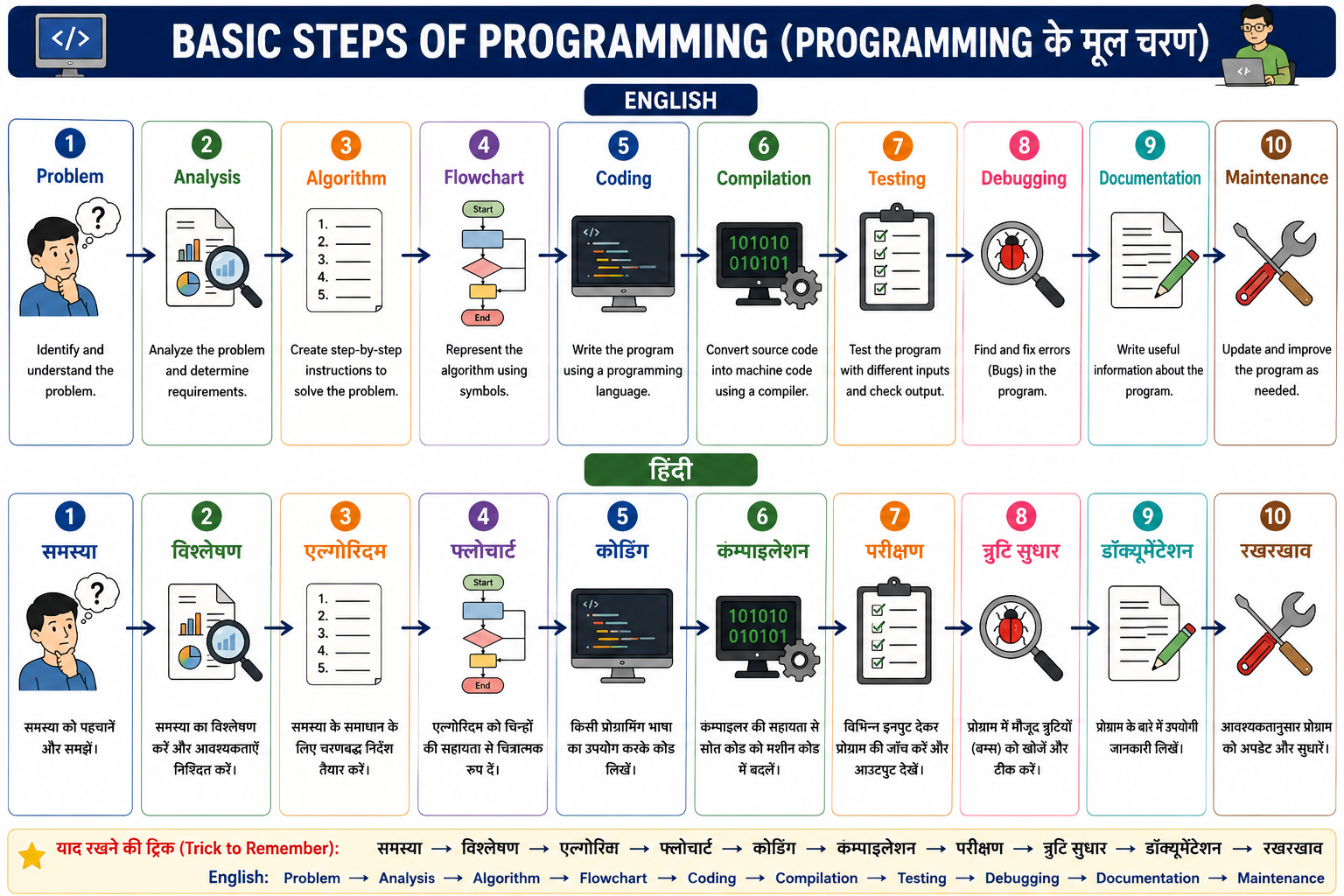
English:
Problem → Analysis → Algorithm → Flowchart → Coding → Compilation → Testing → Debugging → Documentation → Maintenance
हिंदी:
समस्या → विश्लेषण → एल्गोरिद्म → फ्लोचार्ट → कोडिंग → कम्पाइलेशन → परीक्षण → त्रुटि सुधार → डॉक्यूमेंटेशन → रखरखाव
1. Problem Identification (समस्या की पहचान):- हिंदी
प्रोग्रामिंग का पहला चरण समस्या (Problem) को समझना है। प्रोग्रामर यह तय करता है कि किस समस्या का समाधान करना है तथा उपयोगकर्ता (User) की आवश्यकताओं (Requirements) को समझता है।
उदाहरण: किसी छात्र के अंकों का प्रतिशत (Percentage) निकालने का प्रोग्राम बनाना।
English
The first step in programming is to identify and understand the problem. The programmer analyzes the user's requirements and determines what needs to be solved.
Example: Developing a program to calculate a student's percentage.
2. Problem Analysis (समस्या का विश्लेषण) हिंदी
इस चरण में समस्या का विस्तार से अध्ययन किया जाता है। आवश्यक इनपुट (Input), अपेक्षित आउटपुट (Output) तथा समाधान की प्रक्रिया (Process) निर्धारित की जाती है।
English
In this step, the problem is analyzed in detail. The required inputs, expected outputs, and processing logic are identified.
3. Algorithm Design (एल्गोरिद्म बनाना) हिंदी
समस्या के समाधान के लिए Step-by-Step Instructions तैयार किए जाते हैं। इन निर्देशों को Algorithm (एल्गोरिद्म) कहते हैं।
English
An Algorithm is a step-by-step procedure designed to solve a problem before writing the actual program.
4. Flowchart Design (फ्लोचार्ट बनाना) हिंदी
एल्गोरिद्म को चित्रात्मक (Graphical) रूप में प्रस्तुत करने के लिए Flowchart बनाया जाता है। इससे प्रोग्राम की कार्यप्रणाली आसानी से समझी जा सकती है।
English
A Flowchart is a graphical representation of an algorithm using standard symbols. It helps visualize the program's logic.
5. Coding (कोडिंग / प्रोग्राम लिखना) हिंदी
इस चरण में एल्गोरिद्म और फ्लोचार्ट के आधार पर किसी Programming Language (जैसे C, C++, Java, Python आदि) में Program लिखा जाता है।
English
In this step, the algorithm is converted into source code using a programming language such as C, C++, Java, or Python.
6. Compilation (कम्पाइलेशन) हिंदी
Compiler द्वारा Source Code को Machine Code में बदला जाता है। यदि Program में Syntax Errors हों, तो Compiler उन्हें प्रदर्शित करता है।
English
During compilation, the compiler translates the source code into machine code. If there are syntax errors, the compiler reports them.
7. Testing (परीक्षण) हिंदी
Program को विभिन्न Input देकर जांचा जाता है कि वह सही परिणाम (Correct Output) दे रहा है या नहीं।
English
The program is tested with different inputs to verify that it produces the correct output under all conditions.
8. Debugging (त्रुटि सुधार) हिंदी
Program में पाई गई त्रुटियों (Errors/Bugs) को खोजकर उन्हें ठीक करने की प्रक्रिया Debugging कहलाती है।
मुख्य त्रुटियाँ (Types of Errors):
- Syntax Error (सिंटैक्स त्रुटि)
- Runtime Error (रनटाइम त्रुटि)
- Logical Error (तार्किक त्रुटि)
English
Debugging is the process of finding and fixing errors (bugs) in a program.
Types of Errors:
- Syntax Error
- Runtime Error
- Logical Error
9. Documentation (डॉक्यूमेंटेशन) हिंदी
Program के बारे में आवश्यक जानकारी, जैसे उसका उद्देश्य, कार्यप्रणाली, उपयोग तथा Source Code की टिप्पणियाँ (Comments), लिखी जाती हैं। इससे भविष्य में Program को समझना और संशोधित (Modify) करना आसान होता है।
English
Documentation includes information about the program such as its purpose, working, usage instructions, and comments in the source code. It makes maintenance and future updates easier.
10. Maintenance (रखरखाव / अनुरक्षण) हिंदी
Program के उपयोग के बाद यदि नई आवश्यकताएँ आएँ या कोई समस्या मिले, तो Program को अपडेट और सुधारना Maintenance कहलाता है।
English
After deployment, the program may require updates, bug fixes, or improvements. This process is called Maintenance.